HGV Class 1 Training: Cat C+E Buying Guide 2026
- John Dawson
- 1 day ago
- 12 min read
What if the only thing standing between you and a £55,000 annual salary is a single reversing manoeuvre? It's a question many aspiring drivers in Essex ask themselves whilst researching hgv class 1 training and weighing up a new career against the daunting reality of the testing centre. It's completely normal to feel a knot in your stomach when you think about coupling a trailer or trying to decipher the latest Fast Track Car-to-C+E rules. You want a more secure future, but the worry of "cowboy" trainers and hidden fees often makes the first step feel like a risky gamble.
We understand that pressure, which is why this guide is your definitive roadmap to securing your future in 2026. If you're looking to bypass the stress and gain the confidence needed to handle a 44-tonne vehicle, you're in the right place. We'll show you exactly how to pass your Cat C+E test the first time, avoid common pitfalls, and find a reliable partner in Chelmsford who prioritises your success. From the LGV Starter Pack to the New Pass Employment Service, we've got the practical steps you need to master the road and launch a high-earning driving career.
Table of Contents
Understanding HGV Class 1 (Cat C+E) Training in 2026
In the haulage industry, Category C+E is widely considered the gold standard. When you complete your hgv class 1 training, you're qualifying to drive the largest and heaviest vehicles on UK roads. These typically include articulated lorries, often called "artics", where a tractor unit pulls a semi-trailer; or drawbar combinations, which consist of a rigid vehicle towing a separate trailer. Since the legislation changed in November 2021, the path to the cab has become much shorter. You no longer need to pass a Category C (Class 2) test before moving up. This direct access means you can transition from a standard car licence straight to the biggest rigs in the fleet.
Understanding the various HGV/LGV licence categories is vital for anyone planning a career shift. With a current shortfall of over 40,000 drivers in the UK, those who hold a Class 1 licence are in exceptionally high demand. Logistics firms in Essex and beyond are constantly searching for skilled operators to keep supply chains moving. This pressure has pushed competitive salaries higher than ever before. It's a common misconception that you must spend years driving smaller vans before touching a lorry. The modern system is designed to get you behind the wheel of a 44-tonne vehicle quickly and safely.
Class 1 vs Class 2: Which Licence Do You Need?
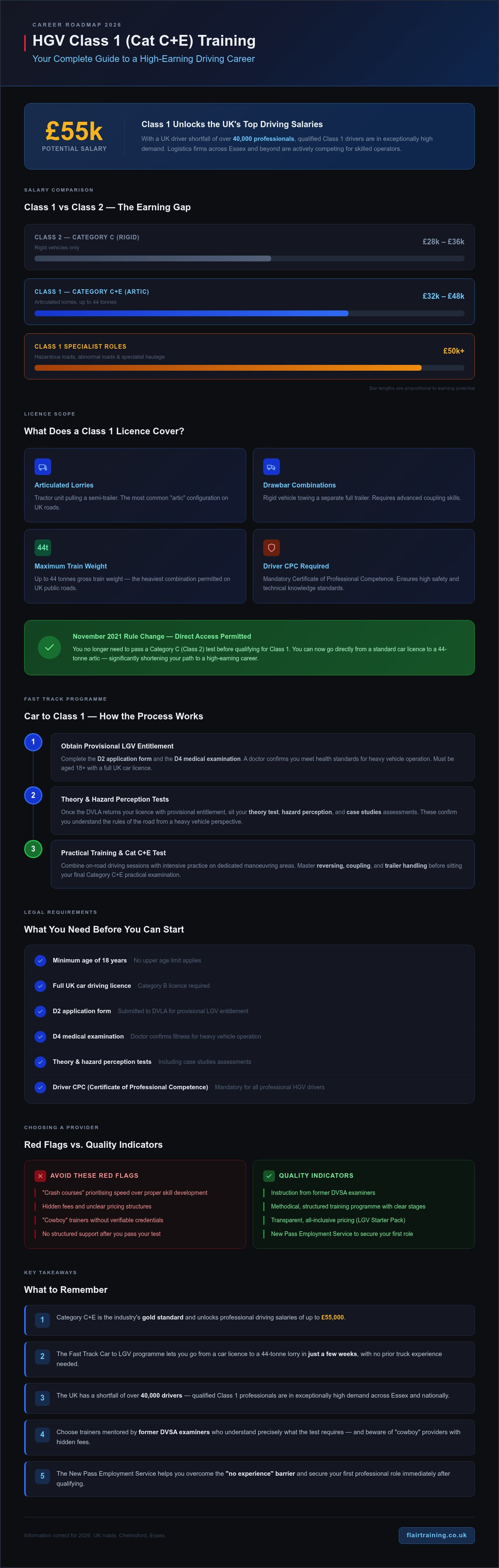
The main difference between the two categories lies in weight and manoeuvrability. A Class 2 (Category C) licence limits you to rigid vehicles, whereas Class 1 allows you to pull trailers up to a total weight of 44 tonnes. While Class 2 drivers typically earn between £28,000 and £36,000, Class 1 drivers often see salaries ranging from £32,000 to £48,000. Specialist roles can even exceed £50,000 per year. For many, the choice is simple. The Fast Track route to Class 1 offers better long-term earning potential for a similar initial investment in training time. If you want the best return on your investment, Class 1 is the logical choice.
The Legal Requirements for UK Drivers
To begin your journey, you must be at least 18 years old and hold a full UK car licence. Your journey starts with paperwork; specifically the D2 application form and the D4 medical examination. A doctor must confirm you meet the health standards required for heavy vehicle operation. Once your provisional entitlement is granted, you'll need to tackle the Driver CPC (Certificate of Professional Competence). This is a mandatory qualification that ensures all professional drivers maintain high standards of safety and technical knowledge. It's not just about passing a test; it's about proving you have the skills to manage a massive vehicle in complex traffic conditions.
The Fast Track Route: Moving from Car to Class 1 Lorry
The transition from a standard car to a 44-tonne articulated vehicle might seem like a giant leap, but the Fast Track Car to LGV programme makes it manageable. This streamlined approach allows you to bypass the traditional requirement of passing a Category C test first. Instead, your hgv class 1 training focuses on building the specific skills needed for larger rigs from day one. It's an efficient way to enter the industry, provided the instruction is methodical and supportive rather than rushed.
Mastering an articulated lorry involves understanding how the trailer pivots and reacts to your steering inputs. While some "crash courses" prioritise speed over safety, professional instruction ensures you develop the muscle memory required for complex manoeuvres. The Road Haulage Association frequently emphasises that maintaining high training standards is essential for road safety and long-term career success. Choosing a structured path means you won't just pass a test; you'll become a competent professional ready for the demands of the UK logistics network.
How the Fast Track Programme Works
The process is broken down into three logical stages to help you progress without feeling overwhelmed. First, you'll need to obtain your provisional LGV entitlement by completing the D2 and D4 forms. Once the DVLA returns your licence, you move to the second stage: the theory and hazard perception tests. These ensure you understand the rules of the road from a heavy vehicle perspective. Finally, you'll begin your practical training, which combines on-road driving with intensive practice on dedicated manoeuvring areas to master reversing and coupling.
Why Beginners Should Choose Structured Training
Rushing into a Class 1 vehicle without a solid foundation carries significant risks, including a higher chance of failing the practical test or feeling unconfident during your first weeks on the job. Flair Training organises the curriculum to build your confidence gradually, using a "step-up" approach that demystifies the size and weight of the vehicle. By learning from mentors who understand the examiner's perspective, you can focus on the specific techniques that lead to a first-time pass. If you're ready to begin, our LGV Starter Pack provides everything you need to kickstart this journey. The Fast Track route is the most time-efficient career path in 2026 for anyone looking to secure a high-earning role in the transport sector.
Evaluating Training Providers: What Makes a Quality Course?
Selecting the right partner for your hgv class 1 training is a decision that impacts your entire career trajectory. It isn't just about finding the cheapest quote; it's about identifying a school that invests in your long-term success. Red flags often include schools with hidden booking fees, outdated equipment, or a lack of transparent pass rates. You want a provider that acts as a mentor, guiding you through the complexities of the industry with honesty and clarity. A low-quality "broker" might sell you a course and then outsource you to a third party, leaving you with no consistency in your instruction.
Quality instruction is built on transparency. If a trainer cannot show you their fleet or explain their pass rates, it's a sign to look elsewhere. You need a team that understands the local landscape of Essex and Chelmsford, as this knowledge is vital when you're navigating the specific challenges of regional test routes. A reliable school will provide a clear breakdown of costs and a structured timeline, ensuring you feel like a partner in the process rather than just another booking in the diary.
The Insider Advantage: Training with Former Examiners
Former DVSA examiners provide an insider's perspective that standard instructors simply cannot match. Because they've spent years conducting tests, they understand the exact marking criteria for both the 3a off-road manoeuvres and the 3b on-road driving assessment. This experience helps demystify the process. It turns a high-stakes exam into a manageable series of tasks, significantly lowering the psychological barrier for new drivers. When your mentor knows exactly what an examiner is looking for during a coupling or uncoupling exercise, your confidence grows naturally.
Infrastructure and Support Services
Your training environment should mirror the real world. This means learning in modern articulated lorries equipped with automatic transmissions, as these are the industry standard in 2026. A quality provider should also offer an LGV Starter Pack to manage the administrative burden, from medical bookings to provisional applications. Training in Chelmsford gives you a distinct advantage; local knowledge of Essex test routes, specific roundabouts, and traffic hotspots means you won't face any surprises on test day. Proximity to the training centre also reduces travel stress, allowing you to focus entirely on mastering your vehicle.
The Roadmap to Your Licence: Steps for Chelmsford Drivers
The path to becoming a professional driver involves more than just time behind the wheel. It's a structured journey through several regulatory and practical milestones. For those starting their hgv class 1 training in Chelmsford, the first step is always the D4 medical assessment. A doctor must verify your fitness to operate heavy machinery, checking everything from your eyesight to your blood pressure. Once you've cleared this hurdle and received your provisional entitlement from the DVLA, the focus shifts to the theory stage. This isn't just one test; it's a three-part challenge consisting of multiple-choice questions, hazard perception clips, and CPC case studies. Mastering these early on ensures you have the technical foundation required for the more intensive practical phases.
The practical side is split into two distinct modules. Module 3a covers off-road manoeuvres, including the reversing exercise and the critical coupling and uncoupling procedure. This is often where nerves kick in, as precision is paramount. Module 3b is the on-road driving test, where you'll be assessed on your safety, observation, and general road behaviour across the Essex road network. If you want to feel prepared for these high-stakes moments, you can learn more about our HGV Class 1 Reversing Practice to see how we guide you through each step of the process.
The LGV Starter Pack: Removing the Admin Burden
One of the biggest hurdles for new entrants is the administrative paperwork. A single mistake on a D2 or D4 form can delay your application by several weeks. A professional LGV Starter Pack removes this burden by bundling the medical booking, form assistance, and theory study materials into one simple package. We support you before you even sit in the cab, ensuring your paperwork is perfect so you can focus entirely on your driving. This early partnership helps demystify the process and gets you on the road much faster.
Preparation for the Practical Examinations
Failing the reversing test often comes down to simple errors, such as losing track of the trailer's position or failing to check blind spots during the manoeuvre. We focus heavily on these common failure points to ensure you're ready for the reversing pad. You'll also need to master the use of the digital tachograph and perform thorough daily vehicle checks. These aren't just for the test; they're essential daily habits for any professional driver. If you're ready to clear the admin hurdles and start your journey, our LGV Starter Pack is the most reliable way to begin.
Beyond the Test: Flair Training’s New Pass Support
The most common worry for any student finishing their hgv class 1 training is the "experience gap". You have the plastic licence in your hand, but you might wonder if a logistics firm will actually trust a new pass with a 44-tonne vehicle. This anxiety is completely natural. Many large-scale hauliers traditionally look for two years of experience, which can feel like an impossible hurdle for a beginner. However, the current landscape of the UK transport sector in 2026 means that reliable, well-trained drivers are more valuable than ever. We don't just leave you at the gates of the testing centre; we act as your partner in the transition from learner to professional.
Our New Pass Employment Service is designed specifically to bridge this gap. Because we've been based in Chelmsford since 2009 and are managed by former DVSA examiners, local hauliers in Essex trust the quality of our graduates. They know that a driver who has trained with us has been mentored by experts who understand the highest safety standards. This localised reliability gives you a significant advantage over those who use generic, nationwide training brokers. We help you turn your qualification into a career by connecting you with employers who value quality instruction over years of potentially bad habits.
Securing Your First Class 1 Driving Role
When you approach logistics companies, how you present your qualification matters. We advise our students on how to highlight the intensive nature of their Fast Track Car to LGV programme and the high standards required to pass. Our reputation amongst Essex hauliers means your application often moves to the top of the pile. Many local firms actively seek out our graduates because they know the training was rigorous and comprehensive. A licence is a tool, but employment support is the result. By leveraging our industry links, you can move straight into a role with a competitive starting salary, often between £32,000 and £34,000 for new qualifiers.
Continuous Professional Development and CPC
Your journey doesn't end once you secure your first job. To maintain your professional status and keep your Driver Qualification Card (DQC) valid, you must complete 35 hours of periodic Driver CPC training every five years. This is a legal requirement for all professional HGV drivers in the UK. Staying on top of these requirements ensures you remain compliant with safety regulations and keeps your skills sharp. Whether you're navigating the M25 or delivering to a tight loading bay in Chelmsford, continuous learning is part of being a top-tier professional. If you're ready to make the leap into this rewarding industry, you can Enquire about our Class 1 Training and Employment Service today.
Secure Your Future on the Road Today
Choosing the right path for your hgv class 1 training is more than just a licensing requirement; it's a strategic investment in your career. By opting for the Fast Track Car to LGV route, you can bypass years of ladder-climbing and move straight into a high-demand industry with significant earning potential. We've explored how a structured approach, led by former DVSA examiners, removes the fear of the reversing pad and ensures you are test-ready from day one.
Based in Chelmsford, our team provides the localised expertise Essex drivers need to navigate regional test routes with confidence. Remember that passing the test is only the first step. Our dedicated New Pass Employment Service is there to ensure your new qualification translates into a professional role quickly. Don't let the administrative burden or the fear of the unknown hold you back from a career that offers both stability and growth. If you're ready to take control of your professional life, we're here to guide you through every mile.
Book Your HGV Class 1 Training with Flair Training Today and join the next generation of professional drivers.
Frequently Asked Questions
How much does HGV Class 1 training cost in Essex?
The total investment to obtain your licence in Essex typically ranges between £2,000 and £3,500. This figure includes your D4 medical, theory tests, and the practical hgv class 1 training course itself. You should look for a package that includes all mandatory fees to avoid unexpected costs during your journey. Industry averages for the course alone usually fall between £1,500 and £3,000.
Can I go straight from a car licence to HGV Class 1?
You can move directly from a standard car licence to a Category C+E licence. Since the legislation changed in late 2021, the government removed the requirement to pass a Category C (Class 2) test first. This Fast Track route is designed to get you into the industry faster. It requires intensive instruction to master the larger articulated vehicles safely from the start.
How long does the HGV Class 1 training course take?
An intensive programme can take as little as 3 to 4 weeks from start to finish. This timeline includes the administrative stages, such as your medical and theory exams. The actual time spent behind the wheel for practical instruction usually spans 5 to 7 days. Your progress depends on your previous experience and how quickly you master the reversing and coupling manoeuvres.
What is the difference between HGV Class 1 and LGV Cat C+E?
There is no difference; they are simply different names for the same qualification. "Class 1" is the traditional industry term, whilst "Category C+E" is the official DVLA classification. Both allow you to drive vehicles over 3,500kg with a trailer exceeding 750kg. These are commonly referred to as articulated lorries or "artics" within the UK haulage and logistics sector.
Is the HGV theory test difficult to pass?
The theory test is manageable if you use the right study materials and practice regularly. It consists of multiple-choice questions and hazard perception clips that focus on the specific risks associated with heavy vehicles. Most students find that dedicated preparation using a structured starter pack makes the process straightforward. This preparation leads to a high first-time pass rate for most learners.
What happens if I fail my HGV Class 1 practical test?
If you don't pass the practical test the first time, you can book a retest after a short waiting period. You'll receive a feedback form from the examiner detailing exactly why you failed. This allows you to focus on those specific areas during extra hgv class 1 training sessions. Our mentors use this feedback to help you polish your technique before your next attempt.
Do I need a medical to start HGV training?
Yes, a D4 medical examination is a mandatory requirement before you can apply for your provisional HGV entitlement. A doctor will check your vision, hearing, and general health to ensure you meet the safety standards for professional driving. This assessment usually costs between £45 and £150. It's a vital first step that confirms you're fit to operate heavy goods vehicles.
How much can a newly qualified Class 1 driver earn in the UK?
A newly qualified Class 1 driver in the UK can expect a starting salary between £28,000 and £34,000. As you gain experience and move into specialist roles or night shifts, your earnings can quickly rise to between £40,000 and £55,000. The ongoing driver shortage ensures that demand for newly qualified professionals remains high across Essex and the rest of the UK logistics network.


Comments