Class 2 LGV Training in Chelmsford: Your Complete Guide to Category C Licences
- John Dawson
- 10 minutes ago
- 12 min read
With nearly 50% of active HGV drivers in the UK now aged 50 or over, the industry is facing a significant generational shift that puts you in the driving seat. If you've been considering a career change, obtaining your class 2 lgv licence is the most reliable way to secure a stable, well-paid future right here in Essex. It's completely normal to feel a bit overwhelmed by the terminology at first. Whether you're confused by the difference between HGV and LGV labels or you're feeling anxious about the practical reversing test, we know exactly how to turn that uncertainty into professional confidence.
We believe that training should feel like a partnership rather than a high-pressure hurdle. Led by former DVSA examiners, our approach provides a clear, step-by-step roadmap to help you navigate everything from the initial D4 medical to the final practical demonstration. You'll learn about the specific DVSA test fees for 2026, the benefits of our Fast Track Car to LGV course, and how our dedicated employment service helps new passes find their feet. By the time you've finished reading, you'll have a transparent plan to trade your car keys for a rigid vehicle and start a rewarding new chapter in transport.
Table of Contents
What is a Class 2 LGV Licence? Understanding Category C
If you're looking to start a career in logistics, the class 2 lgv qualification is usually the first major milestone. It allows you to operate a rigid vehicle, which is a lorry where the cab and the load-carrying area are fixed together on one single chassis. These vehicles range from smaller delivery trucks to massive 32-tonne four-axle lorries often seen on construction sites or making supermarket deliveries. It's the most popular starting point for new drivers because it offers a manageable learning curve while opening doors to thousands of vacancies across the UK.
LGV vs HGV: Clearing the Confusion
People often ask if there's a difference between these two acronyms. In practical terms, they're exactly the same. HGV stands for Heavy Goods Vehicle, a traditional term used for tax and older regulations. LGV stands for Large Goods Vehicle, which is the official designation used by the DVSA. When you start Understanding Category C requirements, you'll see that while Category C1 covers smaller vehicles up to 7.5 tonnes, the full Category C licence gives you the flexibility to drive any rigid lorry. Most Essex employers prefer the full Category C because it allows them to use you across their entire rigid fleet without restrictions.
The Role of a Class 2 Driver
Life behind the wheel of a rigid vehicle is often fast-paced and varied. You won't just be driving; you'll be the face of the company during multi-drop deliveries or regional logistics runs. Many drivers prefer this path because it usually involves daytime shifts and being home every night. Since you aren't dealing with the complexity of an articulated trailer, navigating urban environments like Chelmsford or Colchester becomes much less stressful. You'll need sharp spatial awareness to handle tight corners and excellent time management to keep your schedule on track. It's a role that balances technical driving skill with high-quality customer service, making it a rewarding choice for those who enjoy working with people. Choosing a class 2 lgv path means you can build your experience in a professional environment before deciding if you want to progress to even larger vehicles later on.
The Step-by-Step Roadmap to Your Class 2 LGV Qualification
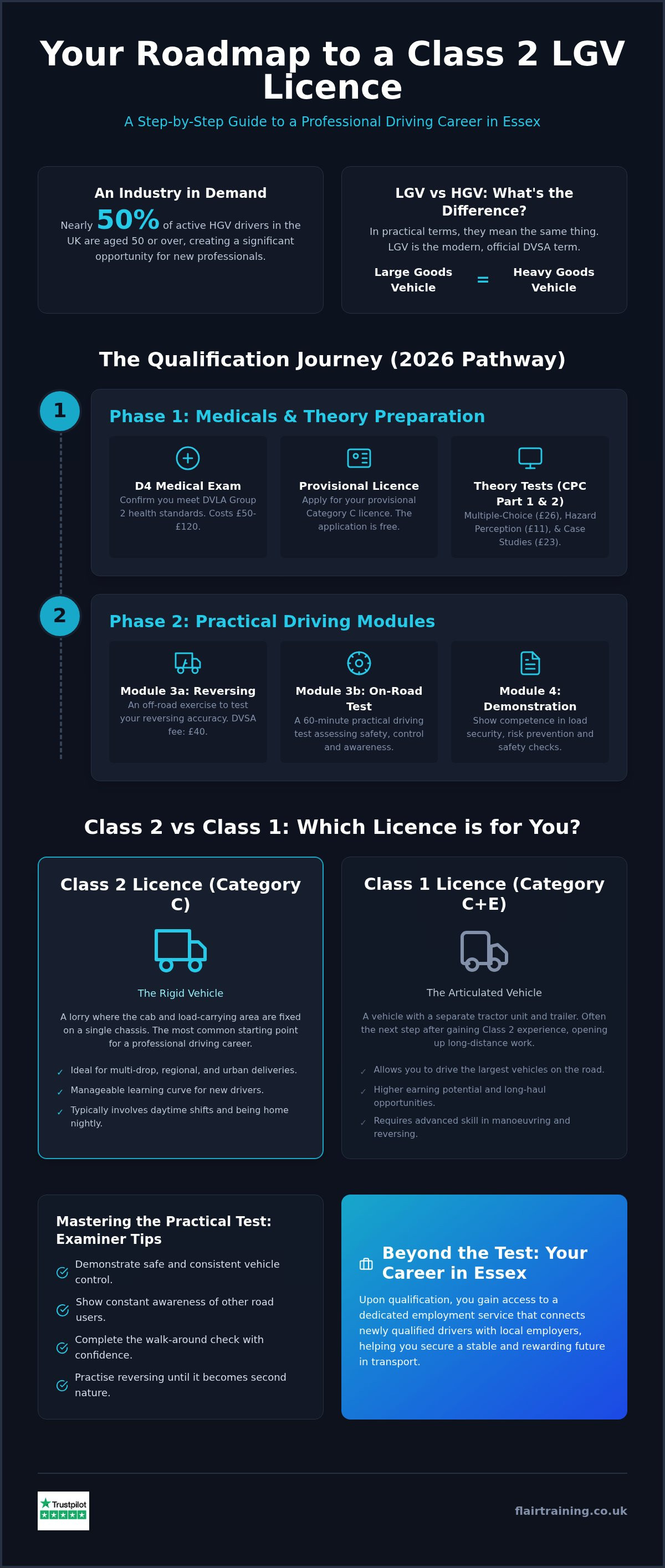
Earning your professional licence in 2026 follows a structured pathway designed to ensure safety and competence on the road. The journey from holding a standard car licence to receiving your Driver Qualification Card (DQC) usually takes between eight and twelve weeks, depending on test availability in the Chelmsford area. We understand that the administrative side can feel daunting, which is why we break the process down into clear, achievable phases. By focusing on one step at a time, you'll build the confidence needed to handle a class 2 lgv vehicle with ease.
Phase 1: Medicals and Theory Preparation
Your first priority is the D4 medical examination. A registered doctor must confirm you meet the DVLA Group 2 health standards, focusing on your vision, hearing, and general fitness. This exam typically costs between £50 and £120. While applying for your provisional licence is free, you'll need to tackle the theory modules once it arrives. These include the multiple-choice test (£26 fee), hazard perception (£11 fee), and CPC case studies (£23 fee). If the paperwork feels like a headache, our LGV Starter Pack handles the logistics for you, bundling your medical and study materials into one simple package.
Phase 2: The Practical Driving Modules
Once the theory is behind you, the focus shifts to the vehicle itself. The practical side of your training is split into three distinct parts:
Module 3a: This off-road exercise tests your ability to reverse the vehicle accurately into a restricted space. The DVSA fee for this part is £40.
Module 3b: This is the 60-minute on-road driving test. Examiners in Chelmsford will look for safe vehicle control, awareness of other road users, and your ability to follow directions.
Module 4: The Practical Demonstration. You'll show that you can secure a load, prevent physical risks, and complete a daily walk-around safety check.
Passing these modules proves you have the technical skill and safety awareness required for Class 2 LGV jobs throughout Essex. Our team, led by former DVSA examiners, ensures you're prepared for the exact criteria used during the assessment. This mentored approach removes the guesswork, allowing you to focus entirely on your new career path.
Class 2 vs Class 1: Which Licence Should You Choose?
Deciding between a Category C and Category C+E licence is a pivotal moment for any aspiring driver. While a class 2 lgv licence allows you to drive rigid vehicles up to 32 tonnes, upgrading to Class 1 opens the world of articulated lorries, often called "artics," with a combined weight of up to 44 tonnes. If you value staying local to Essex and being home for dinner every evening, Category C is often the smarter choice. It focuses on regional deliveries and urban navigation, whereas Class 1 usually involves long-distance "trunking" which might require nights away from home in a sleeper cab.
Choosing the Right Category for Your Lifestyle
Class 2 roles are typically more physically active than their Class 1 counterparts. You'll likely be involved in multi-drop work, which means more climbing in and out of the cab and frequent interaction with customers at delivery points. In contrast, Class 1 driving involves longer periods of sitting behind the wheel on motorways. If you prefer a fast-paced day with plenty of variety, a class 2 lgv career is excellent. If you're comfortable with the added responsibility of a trailer and longer hours, Class 1 offers higher earning potential, though the training takes slightly longer to master.
The Fast Track Lorry Training Option
Since the regulatory changes in late 2021, the law has allowed drivers to go straight from a car licence to Category C+E. We offer a Fast Track Car to LGV Course specifically designed for those who want to jump straight into the highest weight category. This route is efficient, but it isn't for everyone. Many learners still prefer the traditional method of mastering a rigid vehicle first to build their confidence on the road before adding the complexity of a trailer. Following the official guidance found in The Step-by-Step Roadmap to Your Class 2 LGV Qualification is a proven way to ensure you don't feel overwhelmed by the technical demands of the industry.
Training for Category C is generally less expensive and quicker to complete than the full C+E programme. For many, starting here provides a steady income and essential experience while they decide if they want to invest in the upgrade later. Whether you choose the step-by-step approach or our fast-track programme, our New Pass Employment Service is designed to help you secure your first role in the Essex logistics sector as soon as you have your certificate in hand.
Mastering the Class 2 Practical Test: Examiner-Level Tips
Feeling a surge of adrenaline as you approach your test date is completely normal. Because our team is managed by former DVSA examiners, we understand exactly what goes through a candidate's mind when they climb into the cab. The practical class 2 lgv assessment isn't just a test of your ability to move a large vehicle; it's an evaluation of your safety, awareness, and professional attitude. Examiners aren't looking for perfection, but they are looking for a driver who is in total control and consistently thinks ahead of the vehicle.
Technical Manoeuvres: The Reversing Test
The Module 3a reversing exercise often causes the most anxiety, but it is purely a matter of technique and markers. You'll be required to steer the vehicle in an 'S' shape into a designated bay. The key is to keep the vehicle moving slowly whilst keeping your eyes moving between your mirrors. The blind side is the area on the left-hand side of the vehicle where your direct vision is most restricted by the body of the lorry, requiring total reliance on your mirrors and positioning. Many candidates fail here because they stop looking at their surroundings or they cross the boundary lines. If you feel you've lost your positioning, it's often better to take a shunt to correct yourself than to risk hitting a barrier.
Professional Road Craft and Safety
Once you're out on the roads of Chelmsford, your focus must shift to defensive driving. Urban environments are packed with vulnerable road users like cyclists and pedestrians who may not realise how much space a rigid lorry needs to turn. You must demonstrate that you're constantly scanning for these risks. Beyond the driving, you'll also need to show a firm grasp of professional standards from the very start of your day:
The Walk-Around Check: Never rush this. Identifying a frayed tyre or a faulty light before you start proves you take your legal responsibilities seriously.
Tachograph Basics: You'll need to show you understand how to log your hours and the vital importance of taking legal rest periods.
Spatial Awareness: Watch your 'tail swing' and 'kerb clearance' constantly, especially at tight junctions or roundabouts.
Managing test-day nerves comes down to preparation and mindset. If you treat the examiner as a colleague rather than a judge, your driving will feel more natural and fluid. If you want to practice these techniques under the guidance of experts who have sat in the examiner's seat, our Cat C (Class 2) Training provides the hands-on experience you need to pass with confidence. We focus on building your skills until the vehicle feels like an extension of yourself, ensuring you're ready for the road long after the test is over.
Beyond the Test: Finding Class 2 LGV Jobs in Essex
Passing your test is a massive achievement, but the real goal is getting behind the wheel and earning a living. The UK currently faces a structural shortage of between 18,000 and 25,000 qualified drivers, which means the demand for a class 2 lgv holder in Essex is consistently high. In Chelmsford and the surrounding areas, sectors like food distribution, retail transport, and construction logistics are constantly looking for reliable talent. You aren't just looking for any job; you're looking for a role that offers the right balance of pay and shift patterns.
Your first week as a professional driver will likely involve a company induction and "ride-alongs" to familiarise you with specific routes and paperwork. It's a steep learning curve, but it's also where your training truly clicks into place. When writing your CV, focus on your clean licence and your recently acquired Driver Qualification Card (DQC). Employers in the South East value safety above all else, so highlighting your mentored training can give you a significant advantage over other applicants.
Flair Training’s New Pass Employment Service
We don't believe our job ends when the examiner says "pass." One of the biggest hurdles for new drivers is the "experience gap" where some companies hesitate to hire someone without a professional track record. Our New Pass Employment Service bridges this gap by connecting our graduates directly with local logistics partners who trust our standards. When an employer sees you've been trained by former DVSA examiners, it gives them immediate confidence in your road craft and vehicle handling. We provide ongoing support to help you navigate those first few weeks on the road, ensuring you feel like a partner in the industry rather than just another driver.
Career Progression and Earning Potential
The financial rewards in the Essex transport sector are very competitive. The average salary for a class 2 lgv driver in the county is approximately £30,393 per year, though specialised roles or those involving significant overtime can range from £36,400 to £50,000. If you prefer the flexibility of temporary work, PAYE hourly rates in 2026 often start around £18.49 for weekday shifts, with weekend rates rising to over £20.00 per hour. From here, you can choose to specialise in areas like HIAB work or eventually upgrade to Category C+E for long-haul trunking. Ready to start your journey? Explore our Class 2 LGV training packages today.
Start Your Essex Driving Career Today
Transitioning into the transport industry is a significant step, but you don't have to navigate the process alone. You now have a clear roadmap for securing your class 2 lgv licence, from passing that initial D4 medical to mastering the technical reversing exercises. By choosing the right category for your lifestyle, you can enjoy a career that offers both stability and a healthy work-life balance right here in Chelmsford.
Our team, managed by former DVSA examiners, provides the unique insider knowledge that contributes to our high pass rates for Chelmsford students. We pride ourselves on being more than just a training provider; we're your partners in professional growth. From our comprehensive starter packs to our dedicated New Pass Employment Service, we ensure you have the support needed to move confidently from the classroom to the cab. If you're ready to trade your car keys for a professional driving career, we're here to guide you through every mile of the journey.
Book Your LGV Starter Pack and Begin Your Career Today
Frequently Asked Questions
What is the difference between LGV and HGV Class 2?
There is no functional difference between these two terms in the modern industry. HGV stands for Heavy Goods Vehicle, which is a traditional label often used for taxation, whilst LGV stands for Large Goods Vehicle and is the official designation used by the DVSA. Both terms refer to a Category C licence that allows you to drive rigid vehicles over 7.5 tonnes. You'll often see them used interchangeably in job adverts across Essex.
Can I drive a Class 2 lorry on a standard car licence?
You cannot legally drive a vehicle over 3.5 tonnes on a standard Category B car licence issued after 1997. To operate a rigid vehicle between 7.5 and 32 tonnes, you must successfully upgrade your licence to Category C. Whilst some drivers have grandfather rights for smaller 7.5 tonne trucks, the full Class 2 qualification is required for the larger rigid lorries used by most modern logistics firms in the UK.
How much does Class 2 LGV training cost in Essex?
The total investment for your class 2 lgv qualification typically covers medical fees, theory tests, and practical training hours. While official DVSA test fees are fixed, the cost of training packages in Essex varies depending on how much 1-on-1 tuition you require. It is usually more cost-effective to choose a bundled package that includes your initial medical and theory study materials to avoid unexpected administrative expenses later in the process.
How long does it take to get a Class 2 licence from start to finish?
Most students in Chelmsford complete the entire process within eight to twelve weeks. This timeline depends heavily on how quickly you pass your medical and theory exams, as well as the current availability of practical test slots at your local centre. If you stay organised and book your modules consecutively, you can often move from a standard car licence to a professional driving role in just a few months of steady progress.
Do I need to pass a medical test to drive an LGV?
Yes, every applicant must pass a D4 medical examination conducted by a registered doctor before they can apply for a provisional licence. The doctor will check your vision, hearing, and general health to ensure you meet the DVLA Group 2 standards for professional drivers. This safety check is mandatory and must be renewed periodically throughout your career to ensure you remain fit to handle large vehicles on public roads safely.
What is Driver CPC and is it required for Class 2 drivers?
Driver CPC stands for the Certificate of Professional Competence, and it is a legal requirement for anyone driving a lorry professionally. To earn your initial qualification, you must pass four specific modules, including theory tests and a practical demonstration. Once you have passed, you'll receive a Driver Qualification Card (DQC), which you must carry at all times whilst working to prove you are legally qualified to operate commercial vehicles.
Is the Class 2 driving test difficult for beginners?
The test is designed to be challenging to ensure road safety, but it is entirely manageable with the right professional guidance. Most beginners find that the biggest hurdle is adjusting to the size and braking distances of a rigid vehicle compared to a standard car. If you train with experienced mentors who understand the examiner's criteria, you'll build the technical skills and confidence needed to pass your class 2 lgv practical assessment.
What kind of jobs can I get once I have my Category C licence?
A Category C licence opens doors to a wide variety of local and regional roles. You could find yourself working in supermarket retail distribution, multi-drop parcel delivery, or even operating specialist vehicles in the construction industry like skip loaders or cement mixers. Many drivers enjoy these roles because they offer predictable daytime hours and the opportunity to stay local to Chelmsford rather than spending nights away from home in a sleeper cab.


Comments