Cat C vs Cat C+E: Which HGV Licence Do You Need in 2026?
- John Dawson
- 23 hours ago
- 11 min read
Deciding between a Category C (Class 2) and a Category C+E (Class 1) HGV licence is one of the most significant choices you’ll make when starting your professional driving career. For aspiring drivers in Essex, Kent, and East London, this decision directly shapes your earning potential, daily work life, and the types of opportunities available to you. Since a 2021 law change, the path is no longer a fixed ladder; it’s a strategic choice based on your ambitions. Discover the critical differences between Class 1 and Class 2 licences to choose the right career path in the UK logistics industry.
This guide cuts through the confusion, explains the modern "Fast Track" route, and provides the local context you need to invest your time and money wisely.
Table of Contents
Defining the Categories: Cat C vs Cat C+E Lorries
Before we dive in, let's clarify a common point of confusion. The terms 'Cat C' or 'Cat D' can sometimes refer to vehicle insurance write-off categories. This guide is not about insurance. Here, we are discussing the professional driving qualifications, also known as Large Goods Vehicle (LGV) licences, that allow you to drive lorries for a living.
The fundamental difference between Cat C and Cat C+E lies in the vehicle's construction and weight. Understanding this is the first step to choosing your specialism.
Cat C (Class 2): This licence allows you to drive a rigid vehicle. This means the cab and the load-carrying section are permanently fixed together in one solid unit. Think of large removal vans, tipper trucks, or supermarket delivery lorries. The maximum weight for a Cat C vehicle is typically 32 tonnes.
Cat C+E (Class 1): This is the licence for articulated lorries, often called "artics." The vehicle consists of a tractor unit (the cab and engine) that pulls a separate, detachable trailer. This setup pivots, allowing for greater length and flexibility. A Cat C+E licence permits you to drive vehicles up to the UK maximum of 44 tonnes.
Cat C (Class 2): The Urban Specialist
A Class 2 licence is your entry into the world of essential, everyday logistics. These vehicles are the backbone of local and regional distribution, navigating towns and cities to keep businesses stocked and services running.
Typical Vehicles: You'll be behind the wheel of bin lorries, tipper trucks used in construction, large home delivery vehicles, and local distribution lorries.
Your Work Environment: This role is ideal for drivers who prefer shorter, more predictable routes. You might spend your day making multiple drops around Chelmsford, Southend, or the suburbs of East London. The shorter wheelbase of a rigid lorry makes it easier to manoeuvre in tight urban spaces and amongst heavy traffic, which is a significant advantage in busy town centres.
Career Path: Many drivers start with a Cat C licence to build experience and confidence on the road before considering an upgrade. It provides a solid foundation in professional driving.
Cat C+E (Class 1): The Long-Haul Expert
The Class 1 licence represents the pinnacle of HGV driving, opening doors to the highest-paying roles and the largest vehicles on the road. These are the lorries that power the national and international supply chain.
Typical Vehicles: This category is dominated by the large articulated lorries you see on motorways, pulling everything from shipping containers and refrigerated goods to fuel tankers.
Your Work Environment: A Cat C+E licence is essential for "trunking" roles—long-distance hauls between major distribution centres. In our region, this means running regular routes between hubs like DP World London Gateway, the Port of Tilbury, and Felixstowe, often utilising the M25 and A12 corridors.
Career Path: Holding a Class 1 licence offers the greatest flexibility and earning potential in the logistics sector. It qualifies you for almost any HGV driving job, from supermarket trunking to specialised container work.
Training and Testing: Mastering the 3a and 3b Modules
Whether you choose Cat C or Cat C+E, the qualification process follows the same four essential steps: obtaining your provisional licence, passing theory tests, and then completing the two-part practical test. However, the nature of the practical training and testing differs significantly, especially in the off-road manoeuvres.
The journey begins with an HGV medical and applying for your provisional entitlement. Our all-in-one LGV Starter Pack handles all the paperwork for you, so you can focus on preparing for the theory tests. Once those are passed, you move on to the practical exams:
Module 3a: An off-road test of your manoeuvring skills, including the famous reversing exercise.
Module 3b: An on-road practical driving test with a DVSA examiner to assess your general driving ability and safety.
This is where training with former DVSA examiners makes a real difference. We don't just teach you to pass; we give you the examiner's perspective, helping you understand precisely what they need to see on test day. This insight is invaluable for calming nerves and building the confidence needed to succeed first time.
The Reversing Test: Why Cat C+E is Different
The 3a reversing test is often the most daunting part of the process for new drivers. While the principle is the same for both categories, the execution is worlds apart.
Cat C (Rigid): The reverse for a rigid lorry is a precise 'S' shape manoeuvre into a designated bay. Because the vehicle is one unit, your steering inputs have a direct and immediate effect on the vehicle's path.
Cat C+E (Articulated): Reversing an articulated lorry is a completely different skill. You are steering the trailer via a pivot point (the "fifth wheel"). To make the trailer go left, you must initially steer the cab to the right. This counter-intuitive process requires a much higher level of spatial awareness and a feel for how the trailer will react. It's a complex skill, but with expert coaching on our dedicated training yard, our instructors break it down into manageable steps.
Coupling and Uncoupling for Class 1
Another key difference is the coupling and uncoupling module, which is exclusive to the Cat C+E licence. This is a critical safety procedure that you must demonstrate flawlessly during your 3a test.
The Process: You will be required to safely and methodically detach the trailer from the tractor unit and then re-attach it.
Safety Checks: This involves a series of detailed checks on the kingpin, fifth wheel locking mechanism, airlines, and electrical connections. You must follow a strict sequence to ensure the vehicle is secure.
The "Tug Test": A non-negotiable part of the procedure is the "tug test," where you gently pull forward with the tractor unit to confirm the trailer is securely locked before driving off. Getting this wrong has serious safety implications, which is why DVSA examiners and our instructors place such a heavy emphasis on it.
Career Prospects: Salaries and Roles in the South East
The choice between a Cat C and Cat C+E licence has a direct impact on your salary and the type of work you can secure. In the logistics-rich environment of the South East, demand for qualified drivers is consistently high, but the top-tier opportunities are reserved for Class 1 drivers.
In 2026, a newly qualified Class 2 driver in Essex or Kent can expect a starting salary of around £30,000-£35,000. In contrast, a new Class 1 driver can often start on £38,000-£45,000, with experienced drivers earning well over £50,000. The demand for Class 1 drivers, particularly for roles around the M25, Dartford Crossing, and major ports, keeps wages competitive.
Finding that first job can be challenging, which is why we include our New Pass Employment Service with our training packages. We leverage our local industry connections to help our graduates find their first role, connecting them with reputable firms looking for fresh talent for everything from supermarket deliveries to port haulage.
Logistics Hubs in Essex and Suffolk
Our region is a critical node in the UK's supply chain, creating a wealth of opportunities for HGV drivers. The major ports at Tilbury, Purfleet, and Felixstowe are constantly seeking Class 1 drivers to move containers and goods across the country.
Strategic Location: The A12 corridor is the main artery for regional distribution, linking the ports to London and the rest of the UK. This creates huge demand for drivers.
The Role of "Trunking": Class 1 drivers are essential for "trunking"—the process of moving large quantities of goods between a central depot and regional distribution centres. This is the lifeblood of supermarket and e-commerce logistics, and it all happens on our local motorways.
Work-Life Balance: Local vs Long-Distance
Your licence category also influences your lifestyle. This is a crucial factor to consider when planning your career.
Cat C (Class 2): Many Class 2 roles are based on local, multi-drop routes. This often means you are "home every night," with more regular hours and a predictable schedule. If you value being at home and working within your local area, a Cat C role could be a perfect fit.
Cat C+E (Class 1): While many Class 1 jobs are also local, the licence opens up the possibility of "tramping." This involves long-distance work where you may be away from home for several nights a week, sleeping in your cab. While this lifestyle isn't for everyone, it often comes with higher pay and allowances. A Cat C+E licence gives you the choice to pursue the pattern that best suits you.
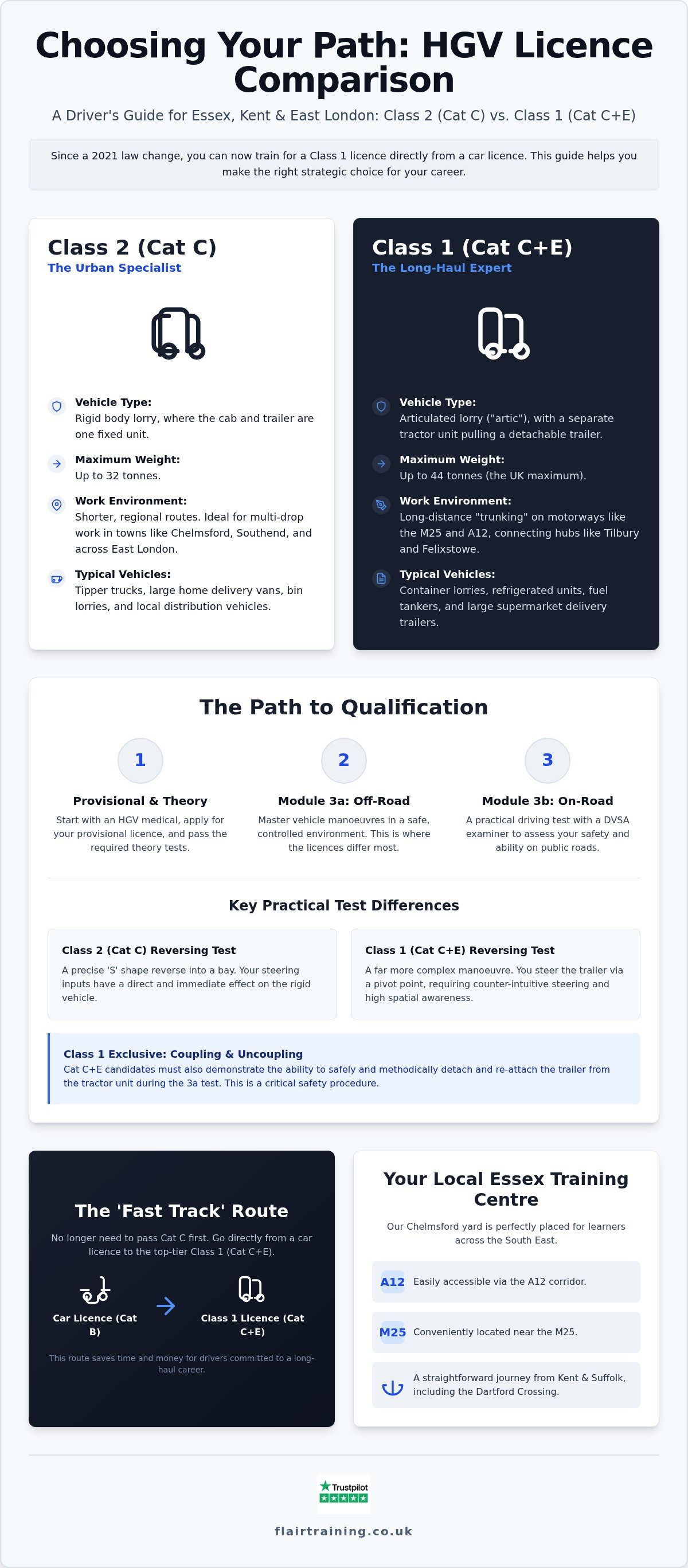
The Fast Track Route: Car to Class 1 Training
Historically, drivers had to pass their Cat C test before they could even think about training for Cat C+E. However, a DVSA law change in 2021 revolutionised the process. You can now go directly from a standard car licence to a full Cat C+E (Class 1) licence without ever taking the Cat C test.
This "Fast Track" approach is now the most popular and efficient way to enter the industry. Our Fast Track car to HGV course is designed to take you from beginner to fully qualified Class 1 driver in the shortest possible time.
Time-Saving: You complete one course of training and one set of tests (3a and 3b), saving you weeks of time compared to the old, two-stage process.
Cost-Effective: By combining the training and taking only one practical test, you save a significant amount of money on course fees and test fees.
Direct to Top Earnings: You qualify immediately for the highest-paying jobs, allowing you to maximise your earning potential from day one of your new career.
Step-by-Step: From Car Licence to 44-Tonnes
The Fast Track route might sound intimidating, but it's a structured and manageable process, especially with the right support.
Get Your Provisional: We start by getting your provisional HGV licence sorted with our LGV Starter Pack, which includes your medical and all DVSA paperwork.
Pass Your Theory: While you're training, you'll also complete your Driver CPC modules, which are essential for driving professionally.
Master the Artic: Our expert instructors will teach you how to handle an articulated vehicle from scratch. You'll learn the unique skills of manoeuvring a large, pivoted lorry without any prior rigid vehicle experience. We find that new drivers often pick this up quickly as they have no "bad habits" from rigid driving to unlearn.
Is Fast Track Right for You?
For the vast majority of aspiring drivers, the Fast Track route is the logical choice. However, it's worth considering your own circumstances.
Confidence Levels: If you are a confident car driver with good spatial awareness, you will likely adapt well to an articulated vehicle. If you are particularly nervous, you might consider the Cat C route first, but we encourage you to speak to our team. Our supportive approach helps even anxious learners succeed.
Financial Investment: The Fast Track course is a larger upfront investment than a Cat C course, but it pays for itself quickly through higher starting salaries. It represents a faster return on your investment.
Check for Deals: We often have special deals on our combined training packages, making the Fast Track route even more affordable.
Why Flair Training is the Best Choice in Essex
Choosing the right training provider is as important as choosing the right licence. At Flair Training, we offer more than just a qualification; we provide a supportive pathway into a new career, built on expertise and local knowledge.
Our Chelmsford-based training centre is perfectly positioned for learners across the South East. With easy access from the A12 and M25, we are a straightforward journey for students from all over Essex, Suffolk, East London, and even Kent via the Dartford Crossing. We combine this convenience with an approach that sets us apart from larger, impersonal "licence factories."
Learn from Experts: Our team is managed by former DVSA examiners. This gives you an unparalleled advantage, as you'll be trained by people who know the test inside and out.
A Supportive Approach: We see ourselves as pragmatic mentors. We understand the pressures of learning to drive an HGV and provide a calm, supportive environment to help you succeed.
Dedicated Employment Support: Our New Pass Employment Service isn't an afterthought; it's an integral part of our commitment to your career. We help you bridge the gap from passing your test to starting your first job.
Examiner-Level Insight
Knowing "what the examiner is looking for" is the key to passing your test. Our instructors provide this insight every step of the way.
Reduce Test Day Nerves: By demystifying the test process and training you to a standard that exceeds the basic requirements, we help eliminate the fear of the unknown.
Focus on Professionalism: We train you to be a safe, professional, and competent driver for life, not just to scrape a pass on the day. This focus on safety and best practice is what employers look for.
Regional Accessibility
We are a local school for local people, and our location reflects that. We are a convenient choice for aspiring drivers across the region.
Essex and Suffolk: Our Chelmsford centre is easily reached via the A12.
East London and M25 Corridor: We are a short drive from the M25, making us accessible for those in the London suburbs.
Kent-Based Learners: The journey to us via the Dartford Crossing is simple, and many of our successful graduates come from Kent, choosing us for our specialist, examiner-led training.
Ready to make a decision and invest in your future? Let's build the perfect training plan for your goals. Get a personalised quote for your training today.
Frequently Asked Questions
Can I go straight from a car licence to a Cat C+E licence? Yes. Thanks to a DVSA rule change in 2021, you can now take the "Fast Track" route and train for your full Cat C+E (Class 1) licence without needing to pass the Cat C (Class 2) test first. This is now the most popular, time-efficient, and cost-effective method. Is it harder to pass the Cat C+E test than the Cat C test? The Cat C+E test involves more complex manoeuvres, specifically the reversing and the coupling/uncoupling exercise. While this can be more challenging, our expert instructors, many of whom are former DVSA examiners, break it down into simple, manageable steps, giving you the confidence and skill to pass. How much more can I earn with a Class 1 licence compared to Class 2? In the South East, a newly qualified Class 1 driver can typically earn £8,000-£10,000 more per year than a new Class 2 driver. This gap often widens with experience, making the Cat C+E licence a significantly better long-term investment. How long does the Fast Track Car to LGV course take? Most students can complete their Fast Track training and test in around 5-7 days, depending on individual progress. This is much faster than the old system, which required two separate courses and tests and could take several weeks. Do I need a new medical if I am upgrading from Cat C to Cat C+E? No. As long as your original HGV medical is still valid (they are typically valid until you are 45), you do not need a new one to add the "+E" entitlement to your licence. What is the reversing test like for an articulated lorry? The reversing test for a Cat C+E vehicle involves accurately guiding the trailer backwards into a coned-off bay. The main challenge is learning to "counter-steer"—turning the cab in the opposite direction to the way you want the trailer to go. It takes practice, but it's a core part of our off-road training. Are there many Class 1 driving jobs available in Essex? Yes, there is huge demand. Essex's proximity to major ports like Tilbury and London Gateway, combined with its position on key routes like the M25 and A12, makes it a prime location for logistics companies. Class 1 drivers are always needed for container haulage, supermarket trunking, and general distribution. What happens if I fail my 3a reversing test? If you fail the 3a test, you cannot proceed to the 3b on-road test. You will need to re-book the 3a test for another day. At Flair Training, we provide targeted remedial training to focus on the specific areas you struggled with, ensuring you are fully prepared and confident for your next attempt.


Comments